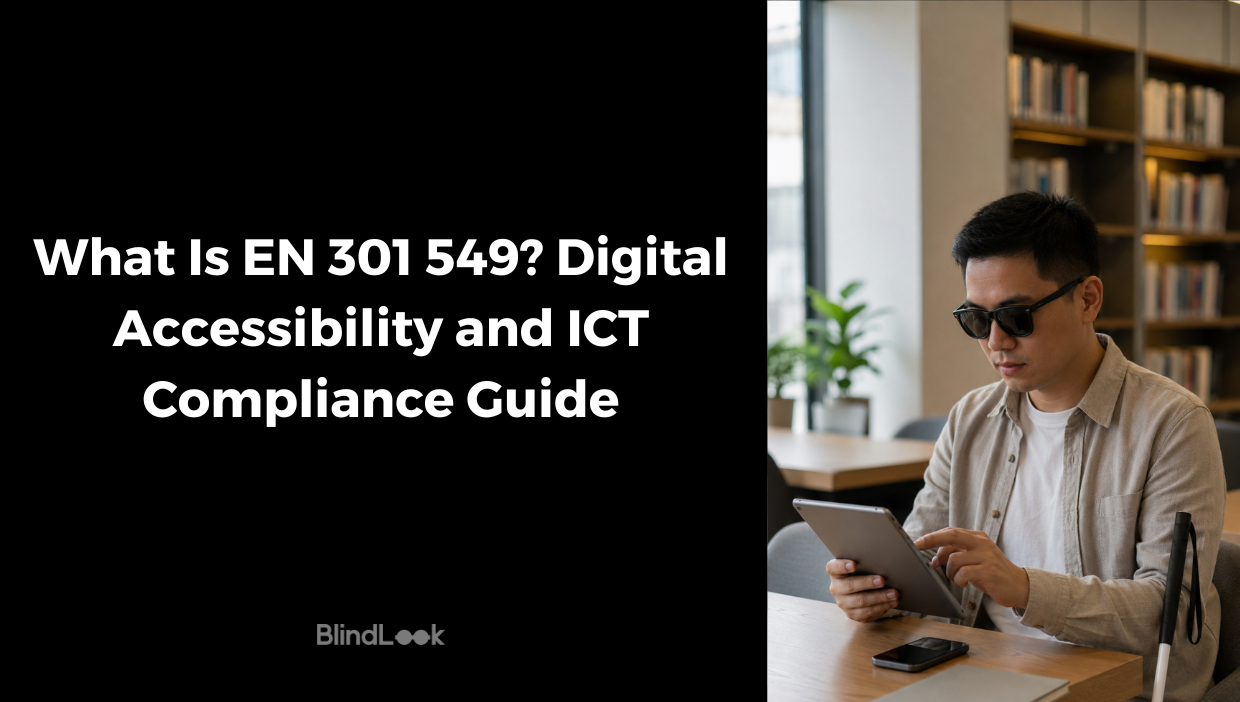
What Is EN 301 549?
EN 301 549 is the European accessibility standard that defines the accessibility requirements for Information and Communication Technology (ICT) products and services. It aims to make various digital assets—including websites, mobile applications, software, digital documents, hardware, and electronic services—more accessible to users with disabilities.
Digital accessibility is not merely a technical checklist. At its core, an accessible experience ensures that any user can smoothly acquire information on a website, complete transactions within a mobile app, read a digital document, or independently navigate a service using a screen reader.
As the pioneering accessibility startup with the highest number of global awards in its field, BlindLook works to make brands' digital and physical experiences more accessible, inclusive, and independently usable. BlindLook delivers a sustainable accessibility transformation for brands in full alignment with EN 301 549 guidelines, WCAG compliance, and real-world user experiences.
Why Is EN 301 549 Important?
EN 301 549 is a comprehensive standard supporting the equitable design of digital products and services. Because this standard is directly linked to European accessibility regulations, it holds immense strategic importance for brands operating on a global scale.
If a website is incompatible with screen readers, if buttons within a mobile app lack proper labeling, if digital documents are not structured accessibly, or if users cannot execute commands using only a keyboard, the digital experience remains locked away from a vast audience.
Compliance with EN 301 549 addresses multiple horizons simultaneously: web accessibility, mobile application accessibility, software accessibility, and document accessibility. By unifying these fields, brands can make their digital assets significantly more intuitive, legally aligned, and user-friendly.
Which Areas Does EN 301 549 Cover?
The EN 301 549 standard spans a diverse spectrum of products and services under the umbrella of information and communication technologies. These include websites, mobile applications, software packages, digital documents, physical hardware interfaces, electronic forms, customer dashboards, and user support channels.
This wide-reaching mandate demonstrates that accessibility cannot be treated as a web-only project. Every digital touchpoint where a user interacts with a brand must be rigorously evaluated for accessibility barriers.
BlindLook analyzes brands' digital assets from end to end. By offering web accessibility analysis, mobile app accessibility testing, WCAG-based technical reviews, complete accessibility audits, and real-world user testing with visually impaired individuals, BlindLook provides an actionable accessibility roadmap.
The Relationship Between EN 301 549 and WCAG Compliance
When defining digital accessibility requirements, EN 301 549 establishes a powerful baseline anchored to the WCAG (Web Content Accessibility Guidelines). WCAG serves as the definitive international technical framework for rendering digital content fully accessible.
WCAG compliance centers on making digital materials perceivable, operable, understandable, and robust. Within this criteria, elements such as heading hiyerarşisi, keyboard-only navigation, screen reader compatibility, color contrast ratios, form field labels, image alternative (alt) text, error feedback, and general user flows are thoroughly audited.
BlindLook reviews websites, mobile apps, and digital content using custom WCAG-based checklists, expert assessments, and real-user testing. This prevents accessibility from becoming a dry, technical box-ticking exercise, transforming it instead into a sustainable process that elevates the overall user experience.
Website Accessibility and EN 301 549
Websites represent one of the most critical digital channels through which brands interface with their audiences. During an EN 301 549 compliance process, a website’s accessibility performance must be evaluated with deep attention to detail.
An accessible website must offer a layout that is compatible with screen readers, easily navigable via keyboard, built with a logical heading structure, styled with sufficient color contrast, and easily understandable for all visitors.
BlindLook analyzes the status of your website to map out potential roadblocks that users might encounter, utilizing technical evaluation, expert analysis, and genuine visually impaired user tests to deliver a holistic overview.
Mobile Application Accessibility and EN 301 549
Mobile app accessibility has become a cornerstone of modern digital inclusion. Users must be able to independently browse an app, execute transactions, fill out input fields, and easily comprehend all operational flows via assistive tools like screen readers.
Under EN 301 549 compliance parameters, mobile apps are checked for proper button labeling, screen reader focus order, adequate touch target sizes, semantic form structures, clear error messages, and cohesive overall user flows.
BlindLook evaluates your mobile applications through real user experiences. This reveals exactly where users experience friction and indicates precisely which sections require immediate optimization.
Digital Document and Software Accessibility
Unlike regulations limited strictly to browser-based interfaces, EN 301 549 explicitly sets forth accessibility requirements for digital documents and software user interfaces.
PDF files, Word documents, presentations, user management panels, and standalone software interfaces must be authored to be compatible with screen readers, styled with logical heading structures, and arranged so that users can interact with content independently.
Accessible documents provide cleaner, better-organized, and more readable content for everyone, not just individuals with disabilities. Consequently, optimizing your documents is a crucial asset in any digital compliance strategy.
Why Is Accessibility Testing Necessary?
Accessibility testing is the single most effective way to gauge how usable a digital product genuinely is for a person with disabilities. Automated testing tools are highly efficient at detecting underlying technical errors, but they cannot evaluate actual human experience on their own.
A platform might check out perfectly on a purely technical validation test. However, if a visually impaired user navigating with a screen reader cannot interpret a button, struggles to submit a form, or gets disoriented in the checkout flow, the experience is functionally inaccessible.
BlindLook evaluates your digital products based on user experience by using real visually impaired user tests. This provides your brand with an actionable, prioritized optimization roadmap rather than an unguided list of automated errors.
What Does EN 301 549 Compliance Offer to Brands?
Achieving EN 301 549 compliance provides substantial benefits both in terms of global regulatory alignment and day-to-day user satisfaction. Accessible digital products organically scale your audience reach, foster deep brand loyalty, and build an inclusive corporate image.
Furthermore, accessibility efforts inherently refine the digital experience for all visitors. Clearer menus, logical forms, structured layouts, and predictable flows enhance overall navigation quality for every single consumer.
Simultaneously, compliance perfectly positions brands ahead of the upcoming enforcement dates of the European Accessibility Act (EAA) and related global guidelines, making EN 301 549 an indispensable benchmark for any business aiming at the global market.
Start Your EN 301 549 Compliance Process with BlindLook
As the pioneering accessibility startup holding the most global awards in its category, BlindLook supports your brand through its complete digital accessibility transformation.
Through specialized website accessibility analysis, mobile application testing, WCAG-aligned checklists, expert technical assessments, thorough accessibility audits, and real visually impaired user experience tests, we build a sustainable accessibility roadmap tailored to your operations.
By integrating BlindLook's systems, you can ensure your digital assets satisfy EN 301 549 metrics and WCAG standards, unlocking an independently usable, fully compliant, and highly inclusive user experience that leads the market.
Frequently Asked Questions
What is EN 301 549?
EN 301 549 is the European accessibility standard that defines specific accessibility requirements for information and communication technology (ICT) products, software, and electronic services.
Which areas does EN 301 549 cover?
The standard covers a broad range of ICT products and services, including websites, mobile apps, software platforms, digital documents (like PDFs), hardware interfaces, and electronic customer support.
What is the relationship between EN 301 549 and WCAG?
WCAG represents the international guidelines used to make web content accessible. EN 301 549 integrates and relies heavily on WCAG criteria to establish its specific requirements for web and digital content.
Why is EN 301 549 compliance important?
It ensures that digital tools are understandable, navigable, and independently usable by individuals with disabilities, while aligning global brands with critical European market regulations.
How does BlindLook help with EN 301 549 compliance?
BlindLook aids brands by providing comprehensive website and mobile app analysis, expert technical audits, WCAG checklist mapping, and real-world testing with visually impaired individuals.
Why should real-user accessibility testing be conducted?
Real-user testing identifies specific, practical barriers encountered by individuals with disabilities that automated tools miss, bridging the gap between theoretical technical compliance and actual user experience.